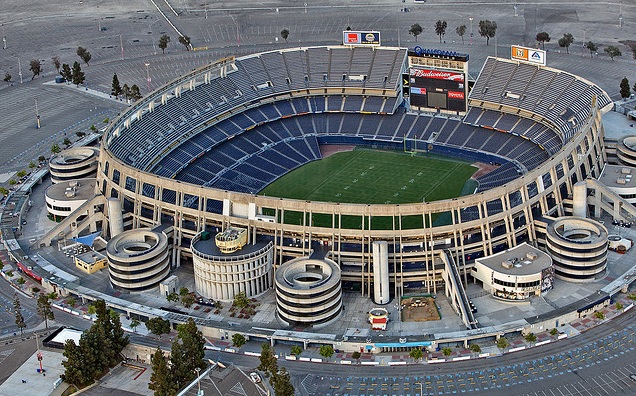
In November 1965, a $27 million bond was passed allowing construction to begin on a brand new stadium for the city of San Diego. Construction on the stadium began one month later. When completed, the facility was named San Diego Stadium. 50 years later, the city loses the Chargers. Why?
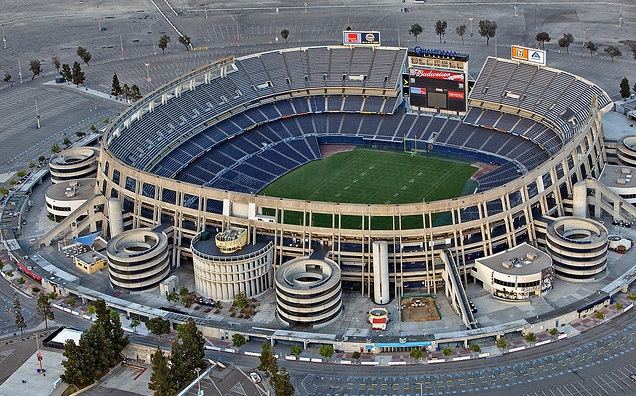
Perhaps the Chargers over reacted. Sure there were leaks in the stadium and the concrete cracking, but why was there not more maintenance and improvements done. Seems like the city of San Diego should have stepped up their game and offered major tax dollars to restore San Diego Jack Murphy Stadium. Sorry Qualcomm, your 20 million dollars naming rights are pretty much over and spent at this point. Seems like letting Qualcomm fall apart came back to bite San Diego in the ass. Dolphins owner Stephen Ross and Chargers chairman Dean Spanos faced similar crises in recent years — neither could muster up enough support to obtain public funds to upgrade their stadiums.
The Dolphins’ $350 million taxpayer initiative died on the floor of the Florida Legislature in 2013, and the Chargers’ half-billion-dollar hotel tax initiative failed spectacularly this past November, receiving only 43.6 percent approval, far short of the 66 percent threshold required to pass.
Ross, the Dolphins’ owner since 2009, responded admirably to his failure. He dropped his veiled threat of relocation, stopped asking for public money, and simply paid for the upgrades himself. The result was a beautifully renovated Hard Rock Stadium that now has a canopy to protect fans from sun and rain.
Spanos, whose family has controlled the Chargers since 1984, responded cowardly. He threw up his hands, stopped looking for a solution, and sold out.
Spanos punched the collective gut of San Diego on Thursday when he announced that he is moving the Chargers to Los Angeles, abandoning the community where they took root for 56 years.
This decision had nothing to do with fan support, and everything to do with public support for a stadium, of which there is little-to-no appetite in California. Spanos took the easy way out. Spanos decided that 56 years of support simply did not matter.
“We pretty much exhausted whatever possibilities that were down there, and it was time to come,” Spanos told San Diego TV station KUSI. “We’re excited to be here and looking forward to spending the next 25 to 30 years here.”
Spanos could have been a hero for San Diego, much like South Florida now appreciates Ross. Miami fans have a nicer stadium, and economic boosters such as Super Bowls and college football championship games will now return.
Instead, Spanos chose to be the villain, and it’s a label that will follow him to the grave, much like it did for former Browns and Ravens owner Art Modell.
Spanos had unsuccessfully spent the last 15 years asking for public money to replace the outdated Qualcomm Stadium, and decided he was out of ideas and out of patience, running off to LA to chase dollar signs. The NFL had granted Spanos an extension until Tuesday to decide on whether to move, but Spanos didn’t need the extra time.
“We live in a great city and we will move forward,” Mayor Kevin Faulconer of San Diego said. “San Diego didn’t lose the Chargers, the Chargers lost San Diego.” That statement seems to be true. While some San Diegan’s might actually drive to LA, the majority never will. Why would Spanos want to alienate that many fans? Perhaps the LA market is all that matters to Spanos at this point. Good luck with that. Why start over? Too bad San Diego did not have an owner that really cared about the long term vision for a beautiful city like San Diego. He could have been the absolute hero in more ways than one. Now, only memories of the Chargers remain.
The Chargers would still likely be in San Diego if their owner had deeper pockets. Spanos, unlike Ross, doesn’t have the individual wealth to simply pay for renovations himself. Forbes lists his family’s wealth at around $2.4 billion, though most of it is theoretical wealth tied to the value of the Chargers. The San Diego Reader estimated last year that Spanos is worth about $200 million outside of the Chargers.
Now Spanos will be forking over as much as $650 million to the NFL in a relocation fee, though the NFL changed its rules to help him pay it. League rules prevent teams from carrying more than $250 million in debt, but in December the owners voted to allow Spanos to borrow up to half of the relocation fee ($325 million).
It’s nice to see the NFL get creative to help one of its own. Too bad the owners couldn’t use that same creativity to help Spanos come up with the funds to renovate Qualcomm, or help build a new stadium. Surely, the $13 billion NFL and its mostly billionaire owners could have found a way.
The Chargers were dead last in the league in total home attendance (456,197) this season.
For many Chargers fans, the move won’t change much. They’ll still get to watch Chargers games on TV (though the team may undergo a complete rebranding — with a new team name and uniforms — within a few years in Los Angeles). Some fans may still drive a couple of hours north to attend the games.
But the Chargers aren’t just playing in a new city. They are detaching from the community they had called home since 1961. Chargers players won’t be visiting San Diego elementary schools on Tuesdays anymore, or holding youth clinics in San Diego’s parks. The team’s charity arm won’t invest as much into the community.
The Chargers meant something to the people of San Diego, even if attendance waned in recent years (Spanos’s threat of relocation obviously played a major role in that).
According to a poll from the San Diego Union-Tribune, 70 percent of San Diegans blame Spanos for the team’s move. Only 6 percent blame Faulconer and 9 percent blame the NFL at large.
“At the end of the day, Dean Spanos was never willing to work with us on a stadium solution and demanded a lot more money than we could have ever agreed to,” Faulconer said. “We could not support a deal that is not in the best interests of San Diego.”
The Rams’ move to Los Angeles last year made sense on several levels, and didn’t engender too many feelings of pity or remorse for the people of St. Louis. The Rams were originally LA’s team, and St. Louis always felt like a temporary landlord.
The Raiders’ potential move to Las Vegas doesn’t boil the blood, either. The Raiders are more of a regional fan base after already moving twice (from Oakland to Los Angeles to Oakland), and Vegas is ready to roll with $750 million in public funding for a stadium already approved.
But this Chargers move stinks all around — NFL greed at its worst. Notably, no one in Los Angeles seems to even want the Chargers. San Diego and LA are two distinct markets, and the Chargers have been decidedly “San Diego” for 56 years.
“We. Don’t. Want. You,” Los Angeles Times columnist Bill Plaschke wrote last week. “The Chargers might not even be in the top-five favorite NFL teams in Los Angeles. The Chargers are San Diego’s team. The Chargers are beloved there. The Chargers belong there.”
Excitement for the Rams wore off quickly as they went 4-12 and had the worst offense in the NFL. Now the NFL is flooding the LA market with a second team, and expects it to be successful? A team with no roots in the community and no sizzle on the field?
As comedian Jimmy Kimmel said of Thursday’s Chargers news, “Fans here in LA reacted the same way we react to opening a Bed Bath & Beyond coupon in the mail.”
But Spanos got his way. The Chargers will now play in a sparkling new stadium in Los Angeles — without having to pay the freight, of course. In 2019, they will be tenants of Stan Kroenke’s $2.6 billion football palace, with the ability to sell luxury suites and personal seat licenses and corporate sponsorships.
It will increase the value of Spanos’s franchise by hundreds of millions of dollars and end the stadium headache that has perplexed him for 15 years.
It was the easy way out. Ross didn’t take it with the Dolphins. Spanos jumped at the chance.
Leave a Reply
You must be logged in to post a comment.