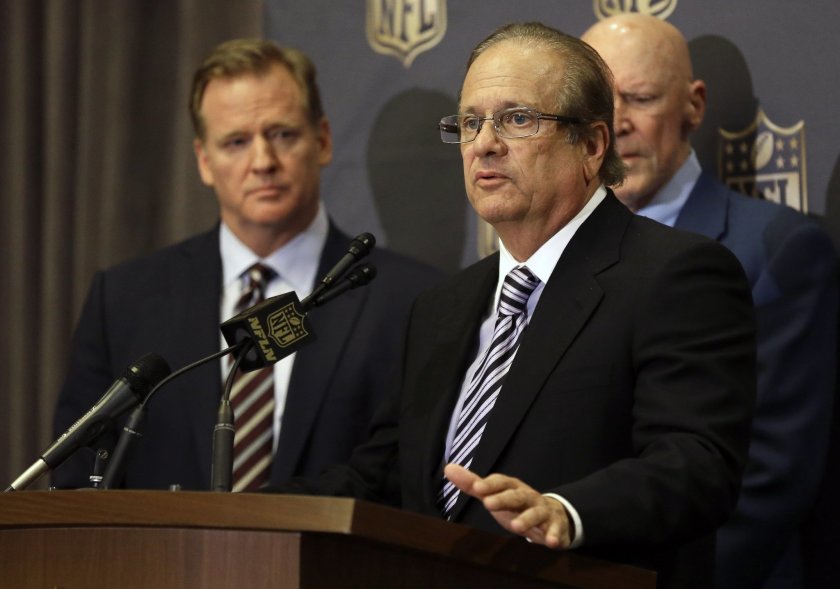
For years, we’ve been documenting how cavalier the National Football League and its franchises can be when its member billionaires’ quest for public money trumps such family values as loyalty and tradition. We’ve shown that when threats to relocate turn into reality, you can count on the billionaires to shed crocodile tears for the fans they’re leaving behind, while pledging eternal fealty to their new marks. So we decided to take another look st the Chargers Rams stadium deal.
One would have thought that Rams owner Stan Kroenke (net worth: $7.4 billion, according to Forbes) set an unbeatable standard for this transparent flapdoodle a couple of years ago, when he grew teary-eyed in front of reporters while discussing the wrenching emotional toll of moving his team halfway across the country from St. Louis to Los Angeles. He called himself a “victim” of circumstances, said, “I never dreamed I’d be put in this position,” and mooned over how bringing the team back to L.A. was the fulfillment of a dream — even though he himself had financed the original move to St. Louis in 1995. Go figure.
But Kroenke has been easily matched in sanctimony by Chargers owner Dean Spanos (family net worth: $2.4 billion), who bid farewell to San Diego with a simple letter assuring fans that their city, which has been the team’s home for 56 years, “will always be a part of our identity.” Yes, it will be remembered as the place where the team notched a dismal record of 416-427-11 and made it to the Super Bowl exactly once (a loss).
Spanos expressed “nothing but gratitude and appreciation for the support and passion our fans have shared with us over the years.” Then he acknowledged that in Los Angeles, where the Chargers will share quarters with the Rams in an Inglewood stadium, “we must get back to winning.”
The truth is that winning in the NFL only matters in one category — revenue. The relocation of NFL teams is never about finding a winning strategy on the field. It’s unrelated to support in the stands or providing the average fan with a better stadium-going experience. This is why salty ex fans will never get over this move. By staying loyal to their SD soil, they leave the Chargers behind. But if they understood that revenue has a lot to do with why teams relocate, perhaps they would still support the team and some still do. The Bolts will soon be playing in one of nicest, if not the nicest stadiums in the NFL. You have to feel good about that. Sure is a shame San Diego did not just vote yes on a new stadium, but this was what Spanos wanted. He wanted the LA market, leaving San Diego as an afterthought.
The closer you look at the Spanos Kronke stadium deal, the more you realize why the Chargers bounced to LA. With the city of San Diego not wanting to give Spanos a bunch of freebies, it finally bogged down. Gave Spanos an easy way out. Some say Spanos planned it that way.
A letter from Dean Spanos pic.twitter.com/rTNIvrsN1A
— Los Angeles Chargers (@Chargers) January 12, 2017
It’s about extracting more money from taxpayers and the wealthiest members of the community, including corporations, by improving their luxury-box accommodations. The biggest chunk of income for teams comes from the leagues’ multibillion-dollar TV contracts, which are shared. So they look for revenue they can keep, which means money from stadium deals. Lets take a closer look at the Spanos Kronke stadium deal:
1) The Chargers pay $1 a year as a tenant at the Inglewood stadium. The Chargers have a 20-year lease for Inglewood then have four five-year options to extend it.
2) The Chargers and Rams each keep their local revenue — tickets, parking, gameday sponsorships, concessions, advertising, etc.
3) Each team kicks in their $200-million NFL G4 loan toward the $2.6-billion stadium‘s construction.
4) For big-ticket items like naming rights, PSLs, jointly sold suites, each team gets an 18.75% cut. Remainder goes toward construction.
5) Neither team is required to sell PSLs and there’s no price guideline if they do. The 18.75% cut incentivizes the Chargers to do so.
6) Side note: one economist (LA Times) who studies the NFL estimated the Chargers could pull in about $300M selling PSLs in L.A.
7) Rams owner Stan Kroenke, backing the Inglewood project, gets all non-football revenues.
8) The Chargers won’t have any role in the mixed-use development surrounding the stadium on the 298 acres in Inglewood.
9) The money from naming rights, PSLs, etc. will flow into Stadco L.A. LLC, a Kroenke-controlled entity that’ll finance the stadium.
10) Probably obvious, but the Chargers won’t be responsible for any cost overruns or similar issues with the stadium.
11) One estimate I’ve seen projects the Chargers will make $75M more in annual local revenue in L.A. vs. a new stadium in San Diego. I haven’t seen a detailed breakdown, but I imagine you can charge more for everything from beers to sponsorships in L.A. About 2/3 of each team’s revenue is fixed from national TV contracts, so, you can still make money w/o selling many tickets.
12) That increase in local revenue — which could be even more — will easily pay off the $650M relo fee over 10 years starting in 2019
13) The basic lease terms have been in place since January 2016; NFL owners formally approved the arrangement shortly thereafter.
Kroenke will own the stadium – Basically, Kroenke is assuming the risk/debt and the Chargers get a good lease in exchange for their contribution. In a way, Spanos has a lot less to worry about, as he basically gets to make a killing off anyone who shows up for a Charger game. So this deal is makes the Chargers more than just a tenant in the Kroenke palace. Deano gets to keep all revenue from games and contributes to the stadium construction (not his money – PSLs and G4).
So Dean will kick in 200 mil in G4 loan (more like a grant) from NFL, And may be 200 million more from PSL sales. And the 650 million in relocation fees.
But in 10 years, he could clear free of all debt. Shrewd business plan!
If the Chargers sell PSLs in Los Angeles, I doubt that the Bolts will revert back to San Diego ever. Spanos would have to repay that money. Plus it all goes to the stadium construction anyway. It was a truly a sweetheart deal for Team Spanos. Perhaps because the NFL wanted two teams in Los Angeles.
A hotel tax also was the linchpin of a Chargers ploy to get a new stadium in San Diego without spending too much of the Spanos fortune. The local hospitality industry balked, asserting that the tax would render San Diego hotel rooms uncompetitive and threaten the city’s claim on such reliable annual events as the Comic-Con convention. In still seems like yesterday, but the voters rejected the proposal to raise the hotel tax to 16.5% from 12.5% to produce more than $1 billion.
By then, most San Diegans were understandably fed up with the Chargers, which had been playing in the city’s Qualcomm Stadium. The city has been operating the stadium at an annual loss. In May 2015, the Spanos family turned a cold shoulder to a $1.3-billion financing plan for a replacement that would have demanded $121 million in public funding each from taxpayers of the city and county of San Diego, plus the $225-million proceeds of the sale of city land to private developers.
Fans would still be expected to fork over $100 million in the form of seat licenses and parking fees. About $173 million would come from public bonds, backed by team rent. The 60 acres of city land on which the stadium would rise was valued at another $180 million. That is a lot of free stuff for your boy Deano. The Spanos family kept putting roadblocks in front of this plan, until San Diego Mayor Kevin Faulconer finally concluded that the team simply didn’t want to stay in what it seemed to consider a backwater.
NFL host cities — including Inglewood, where the Rams and eventually the Chargers will play — shouldn’t overlook the warnings implicit in these deals. St. Louis was among the communities that gained from the NFL’s trend toward moving from big cities to second-tier cities in search of lavish stadium handouts during the 1980s and 1990s. The strategy also brought teams to Indianapolis, Phoenix, Nashville, Jacksonville, Charlotte and (back to) Oakland. Only recently did the league get serious again about placing a team in Los Angeles — now two teams.
But all this moving around is just proof that the NFL doesn’t really care about any particular hometown. Everyone is vulnerable, once their state-of-the-art stadiums yield to the ravages of time and fashion and the teams start whining for more money, more luxury boxes, a better deal, and then go looking around for better deals. Someday Inglewood Stadium will need renovation too. For now, it looks like the Chargers are doing just fine in LA despite what seems like a lack of fans, but the visiting teams fans drink beer also. So from a business standpoint, in the short term, Spanos should come out ahead. Long term remains to be seen however. So we will soon see the Chargers sharing quarters with the Rams in an Inglewood stadium that is now almost completely built. So now after reading this, do you think maybe a few salty ex Charger fans make it up to LA next year?
Leave a Reply
You must be logged in to post a comment.